A line that delivers 8 bags of 25 kg per minute puts 12 tonnes per hour in the hands of whoever palletizes. Brazilian legislation treats that effort with care: the labour code (CLT) sets 60 kg as the maximum weight an employee may move individually, and the ergonomics regulation NR-17 forbids non-occasional lifting that may compromise health when the grip is more than 60 cm from the body. The NIOSH lifting equation, an international ergonomics reference, starts from a load constant of 23 kg, which applies in full only under ideal conditions and decreases with horizontal distance, height, vertical travel, twisting, frequency and grip quality.
The same NR-17 lists, as the first prevention measure for manual load handling, the implementation of technical aids. The palletizing robot is the most complete of them. This guide shows how it is sized.
What robotic palletizing is
Palletizing is building the unit load: boxes, bags, bundles or pails stacked on the pallet in stable layers, ready for transport and storage. In robotic palletizing, an industrial robot picks the product at the line exit and places it according to the programmed pattern.
A typical cell has an infeed conveyor, a robot with gripper, one or two pallet positions, safeguards and, depending on the project, automatic feeding of empty pallets and slip sheets.
Why a palletizing robot has 4 axes
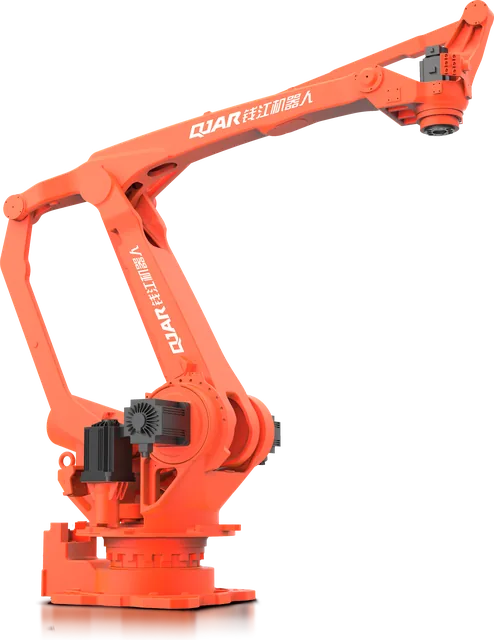
Stacking requires positioning the load in three dimensions and rotating it about the vertical axis. It does not require tilting. The 4-axis palletizing robot takes advantage of that: its structure keeps the flange always parallel to the floor, and the fourth axis rotates the gripper.
With fewer moving axes, the arm is simpler and more direct for the task. A 6-axis robot comes in when the product has to be tilted or reoriented, which is the exception. The difference between the two families is in the industrial robot guide.
The three figures that size the robot
Payload: product plus gripper
Datasheet payload is everything beyond the flange. The gripper counts and, depending on the product, can weigh as much as the product itself.
| Case (example values) | Product per pick | Gripper | Wrist payload | Model in the line that fits |
|---|---|---|---|---|
| 5 kg box, one per pick | 5 kg | 4 kg | 9 kg | QJRB15-1 (15 kg) |
| 12 kg box, one per pick | 12 kg | 8 kg | 20 kg | QJRB30-1 (30 kg) |
| 25 kg bag, two per pick | 50 kg | 30 kg | 80 kg | QJRB180-1 (180 kg) |
| Layer of 12 boxes of 20 kg | 240 kg | 150 kg | 390 kg | QJRB800-1 (800 kg) |
The decision to pick one or more products per cycle changes the robot class: two 12 kg boxes with the same 8 kg gripper add up to 32 kg and already exceed the 30 kg model. That is why payload and cycle are defined together.
Reach: from the farthest pallet corner to the top of the stack
The robot has to place at the farthest corner of the first layer and at the highest point of the last one. The Brazilian standard pallet, the PBR, measures 1,000 mm by 1,200 mm and is 129 mm high, according to the ABRAS specification. Added to that are the final load height, the position of the pick point and, when there are two pallet positions, the distance between them.
A robot serving two pallet positions works without stopping during pallet exchange: while a full pallet leaves, it carries on at the other one. That choice calls for more reach.
Cycle rate: the line is in charge
The number of cycles per minute comes from the line, not from the catalogue:
- products per minute at the line exit;
- divided by the number of products per pick;
- equals the cycles per minute the robot must meet.
A line running 12 boxes per minute with double pick needs 6 cycles per minute. Whether the robot meets that rate depends on the distance between pick and place, the total load and the pallet pattern. That check is done in simulation, with the real layout, before purchase.
The QJAR palletizing line
| Model | Payload (kg) | Reach (mm) | Axes | Repeatability (mm) | Mass (kg) |
|---|---|---|---|---|---|
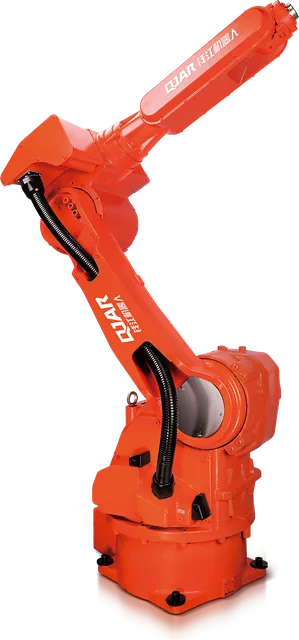
| QJRB15-1 | 15 | 1,510 | 4 | ±0.05 | 160 |
| QJRB30-1 | 30 | 1,820 | 4 | ±0.05 | 205 |
| QJRB180-1 | 180 | 3,153.7 | 4 | ±0.5 | 1,400 |
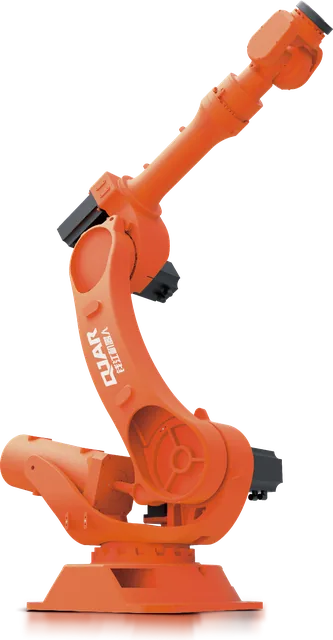
| QJRB800-1 | 800 | 3,159 | 4 | ±0.5 | 2,550 |
The first two are compact, for boxes and light packages in cells with limited floor space. The QJRB180-1 combines 180 kg with more than 3 m of reach, enough for bags with multiple pick and, depending on the layout, two pallet positions. The QJRB800-1 takes 800 kg to 3,159 mm, for full layers or heavy unit loads.
Robot mass also enters the project. An arm of 1,400 kg or 2,550 kg in motion transmits forces to the base, and the foundation is calculated for that.
Gripper: the component that changes the project most
The robot is chosen after the gripper, not before.
| Gripper type | Typical product | Note |
|---|---|---|
| Vacuum | Boxes with a flat, closed top face | Light and fast; depends on box quality |
| Fingers or fork | Bags | Supports from below; needs a roller conveyor at the pick point |
| Side clamp | Boxes, bundles and crates | Squeezes the sides; mind the strength of the packaging |
| Combined | Product, empty pallet and slip sheet | One tool for three functions, with more mass |
Gripper mass uses up payload, and its size defines what fits between the stacks. In many projects, it is the gripper design that allows, or prevents, the multiple pick that closes the cycle.
Pallet pattern and load stability
The pattern of each layer defines load stability and pallet utilization. Alternating layers, with staggered joints, lock the stack. Slip sheets help with products that slide.
The pattern also defines the robot's work: how many different orientations per layer, how much rotation per cycle and how much clearance between products at placement. A pattern that is good for transport and bad for the cycle is a problem that shows up early when the project is simulated.
Cell layout and safety
A palletizing cell has two boundaries crossed by people and equipment: the product infeed and the pallet exit. Brazil's NR-12 requires hazard zones to have safety systems, characterized by fixed guards, movable guards and interlocked safety devices.
At the pallet exit it is common to use a light curtain with muting, the automatic and temporary disabling of the safety function while the pallet passes, as defined in the regulation itself. The curtain position is not arbitrary: Annex I of NR-12 adopts the minimum distance calculation of ISO 13855, which depends on the stopping time of the system.
The full requirements are in NR-12 for robot cells. For light tasks with people nearby there is the collaborative alternative, compared in collaborative robot vs industrial robot.
When the robot is the choice
- More than one product or format. Changing the pattern means changing the program.
- Short space at the end of the line. The cell takes little more than the reach of the arm.
- Two lines close together. One robot can serve both, each with its own pallet.
- Loads that change. A combined gripper and different programs absorb new packaging without replacing the machine.
Data for the quote
- Product: dimensions, mass and type of packaging.
- Line rate, in products per minute, and number of shifts.
- Pallet used and final load height.
- Present or desired pattern, and use of slip sheets.
- End-of-line layout, with conveyor height.
- How the full pallet leaves: pallet truck, forklift or conveyor.
- How many different products run on the same line.
With this data, the payback calculation can be done with the plant's own numbers, following the structure in industrial robot cost. The project is led from start to finish by the robot integrator.
Frequently asked questions
What is a palletizing robot?
It is an industrial robot, usually with 4 axes, that picks products at the end of the line and stacks them on the pallet following a layer pattern. It works with a gripper suited to the product, inside a cell with product infeed, pallet position and safeguards.
How many kilograms can a palletizing robot handle?
It depends on the class. The QJAR line has palletizers with 15, 30, 180 and 800 kg wrist payload. That payload includes the gripper: a 25 kg product with a 30 kg gripper uses 55 kg of the robot's capacity.
Why does a palletizing robot have 4 axes?
Because stacking requires positioning the load in space and rotating it about the vertical axis while keeping it level. The 4-axis arm keeps the flange parallel to the floor by design, with fewer moving axes than a 6-axis robot for the same task.
How many boxes per minute can a robot palletize?
The calculation starts from the line: products per minute divided by the number of products per pick gives the cycles per minute the robot must meet. Whether it does depends on the distance between pick and place, the load and the pallet pattern, which is confirmed in simulation.
Does a palletizing cell need safeguarding?
Yes. Under Brazil's NR-12, hazard zones need safety systems, characterized by fixed guards, movable guards and interlocked safety devices. At the pallet exit a light curtain is common, and its minimum distance follows the calculation in Annex I of the regulation, based on ISO 13855.
Talk to BR Robotics
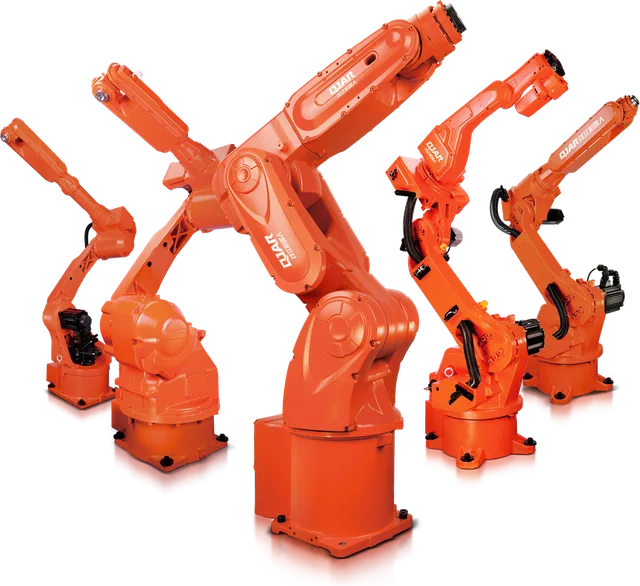
BR Robotics sizes and integrates palletizing cells with QJAR robots from 15 kg to 800 kg. Send the product, the line rate and the layout: the reply comes with the recommended model, the cell layout and the quote. Talk to BR Robotics, see the robot range or the palletizing line datasheets.
Sources
- CLT, Decree-Law No. 5,452/1943, article 198 (Brazilian Presidency, in Portuguese)
- NR-17, Ergonomics, chapter 17.5 (Brazilian Ministry of Labour and Employment, in Portuguese)
- NIOSH, Revised NIOSH Lifting Equation (CDC)
- CCOHS (Government of Canada), NIOSH Lifting Equation: calculating the recommended weight limit
- ABRAS, technical specification of the PBR-I pallet (in Portuguese)
- NR-12, Safety at Work in Machinery and Equipment, item 12.5 and Annex I (in Portuguese)
- ISO 13855:2024, Safety of machinery: Positioning of safeguards with respect to the approach of the human body
- EVST Brasil, QJAR line datasheets