An industrial robot is bought on its datasheet and approved, or rejected, by the process. Two arms with the same rated payload can deliver opposite results in the same cell, because reach, repeatability, number of axes and mass change what fits in the layout and what the process tolerates.
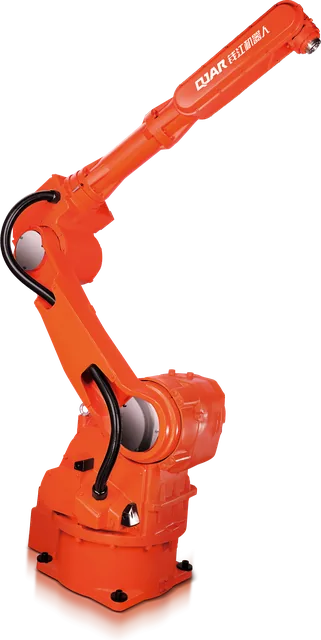
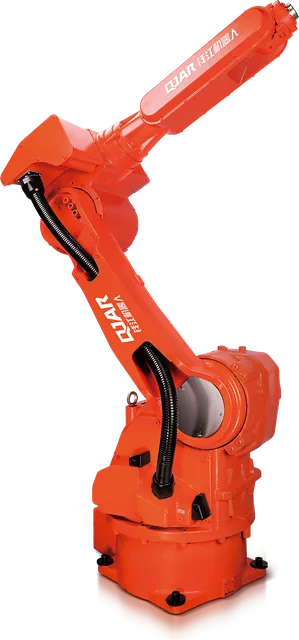
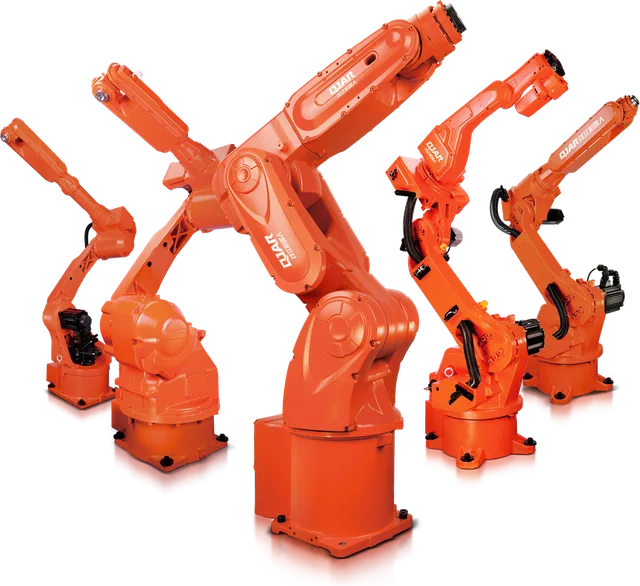
This guide explains what the standard calls an industrial robot, which types exist, how to read each figure on the datasheet and which questions must be answered before requesting a proposal. The examples use the QJAR line, integrated in Brazil by BR Robotics.
What an industrial robot is
The definition used worldwide comes from ISO 8373, the robotics vocabulary standard, and it is the one adopted by the International Federation of Robotics (IFR) in its statistics: an industrial robot is an automatically controlled, reprogrammable, multipurpose manipulator, programmable in three or more axes, either fixed in place or fixed to a mobile platform, for use in automation applications in an industrial environment.
Three terms in that definition have practical consequences:
- Reprogrammable: motions change by program, with no mechanical alteration. This is what separates a robot from a dedicated machine.
- Multipurpose: the same arm welds, palletizes or handles parts by changing the tool and the program.
- Axes: each axis is an independent motion. The number of axes defines what the wrist can do with the tool.
There is one point the definition does not show. For ISO 10218-1, the robot alone is partly completed machinery: the work is done by the application, that is, the robot with its tool, part, fixtures and safeguards. This is why model selection is never separated from cell design, which is the job of the robot integrator.
The market confirms the pace of adoption. According to the IFR, the global operational stock reached 5 million units in 2025, with more than 600,000 installations in that year. Brazil installed almost 4,300 new robots in 2025, up 38%, driven by the automotive industry.
Types of industrial robot
Classification by mechanical structure is the one that guides selection.
| Type | Structure | Where it performs best |
|---|---|---|
| 6-axis articulated | Three or more rotary joints, with a three-axis wrist | Welding, painting, handling, machine tending, assembly |
| 4-axis articulated | Arm whose flange is kept parallel to the floor | Palletizing and end of line |
| SCARA | Two parallel rotary joints, rigid in the vertical direction | Assembly and pick and place of light parts in one plane |
| Delta (parallel) | Arms linked in a closed loop to a platform | High-rate pick and place of light parts |
| Cartesian | Three perpendicular linear axes | Gantries and long straight strokes |
A collaborative robot is not a mechanical type. It is a type of application, with its own safety rules, covered in the comparison between collaborative and industrial robots.
How to read the datasheet: the five figures
Payload
It is the mass the robot moves at its wrist with guaranteed performance. The sum includes everything beyond the flange: tool, part, cables and hoses. A 9 kg gripper with a 14 kg part adds up to 23 kg and already rules out a 20 kg robot, even though the part alone would fit.
Mass is not the only limit. The farther the centre of gravity sits from the flange, the higher the moment on the wrist axes. This is why every model has a load diagram, and the diagram decides, not the figure on the catalogue cover.
Reach
It is the maximum distance the wrist reaches from the base. The usable volume is smaller than that sphere: there is a region near the base the arm cannot reach and, at the extremes, the robot gets to the point but has no freedom left to orient the tool. A welding torch must arrive at the joint at the right angle, not merely touch the part.
Excess reach also has a cost. A larger arm takes more floor space, weighs more and needs safeguards placed farther away.
Number of axes
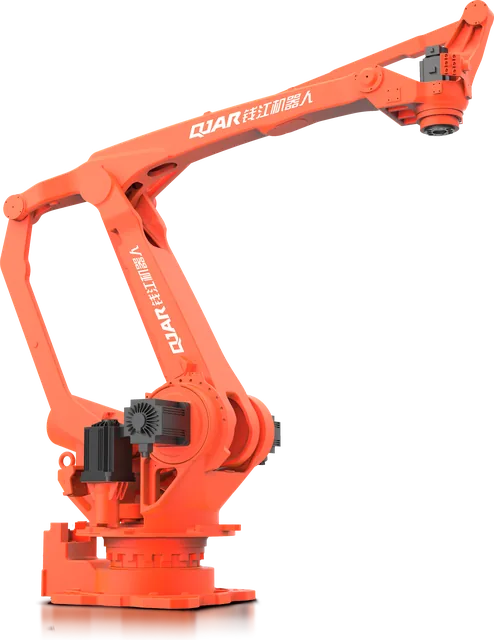
With 6 axes the robot positions and orients the tool freely, which welding, painting and handling with rotation require. With 4 axes the flange stays parallel to the floor and the load only rotates about the vertical axis, which is exactly what stacking boxes and bags needs. The criteria for that application are in the palletizing robot guide.
Repeatability
It is the scatter of the robot when it returns many times to the same programmed point, measured according to ISO 9283. Do not confuse it with accuracy, which is the difference between the point commanded by coordinates and the point actually reached.
When points are taught inside the cell, repeatability is what counts. Accuracy starts to matter when the program is created outside the cell, in simulation, and has to match the real world.
The required band comes from the process. A bead of robotic welding on thin sheet calls for tenths of a millimetre or less. A box on a pallet tolerates half a millimetre with room to spare.
Robot mass
It defines the base, the anchoring and the floor load. A model with a 6 kg payload weighs 170 kg. An 800 kg palletizer weighs 2,550 kg and needs a foundation designed for dynamic loads, not only for static weight.
The QJAR line in figures
The table shows how these five figures combine across a complete line. Values are those published by the manufacturer and are available on the EVST Brasil website.
| Model | Main application | Payload (kg) | Reach (mm) | Axes | Repeatability (mm) | Mass (kg) |
|---|---|---|---|---|---|---|
| QJRH4-1A | Arc welding | 4 | 1,410.5 | 6 | ±0.03 | 150 |
| QJR6-1400H | Arc welding | 6 | 1,456 | 6 | ±0.08 | 150 |
| QJR6-2000H | Arc welding | 6 | 2,014 | 6 | ±0.08 | 230 |
| QJR6-1 | General purpose | 6 | 1,441 | 6 | ±0.03 | 170 |
| QJR10-2000 | General purpose | 10 | 2,001 | 6 | ±0.05 | 275 |
| QJRB20-1600 | General purpose | 20 | 1,668 | 6 | ±0.05 | 270 |
| QJR50-1 | General purpose | 50 | 2,012.4 | 6 | ±0.07 | 580 |
| QJRB210-1 | Heavy payload | 210 | 2,688 | 6 | ±0.2 | 1,257 |
| QJRB15-1 | Palletizing | 15 | 1,510 | 4 | ±0.05 | 160 |
| QJRB30-1 | Palletizing | 30 | 1,820 | 4 | ±0.05 | 205 |
| QJRB180-1 | Palletizing | 180 | 3,153.7 | 4 | ±0.5 | 1,400 |
| QJRB800-1 | Palletizing | 800 | 3,159 | 4 | ±0.5 | 2,550 |
| QJRP10-1 | Painting | 10 | 2,035 | 6 | ±0.5 | 370 |
| QJR6-2700P | Painting | 6 | 2,701 | 6 | ±0.5 | 400 |
Three readings the table allows:
- Repeatability follows the process. The 4 to 6 kg models for welding and fine handling work between ±0.03 and ±0.08 mm. The 180 and 800 kg palletizers work at ±0.5 mm, which is more than stacking requires.
- The mass-to-payload ratio drops in large robots. The QJR6-1 weighs about 28 times the load it moves. The QJRB800-1 weighs just over 3 times. Heavy-payload robots are structures optimized for force, and the base has to be designed accordingly.
- Reach and payload do not grow together. The QJR6-2700P takes 6 kg to 2,701 mm, because painting needs a large envelope with a light tool. The QJR50-1 takes 50 kg to 2,012.4 mm.
How to choose: six questions before the proposal
- What is the process and what tolerance does it allow? Welding, palletizing, painting and machine tending call for different robot families.
- How much does the assembly at the wrist weigh, and where is its centre of gravity? The tool is part of the calculation from day one.
- Which points must be reached, and with what orientation? The answer comes from the 3D model of the part and the fixture, not from a tape measure.
- What is the target cycle time? The cycle defines whether one robot is enough and which payload class keeps the required acceleration.
- What is the environment like? Weld spatter, dust, paint mist and temperature change protection, cabling and certifications.
- Who integrates, who documents safety and who provides support? In Brazil the cell must comply with NR-12, and someone is technically responsible for it.
The answers do not come from a catalogue. They come from a study carried out with the real part, and that is the work BR Robotics does when it recommends the model and the cell layout.
Common mistakes in selection
- Choosing by rated payload and forgetting the tool and the lever arm.
- Buying excess reach and paying for it in floor space, base and safeguards.
- Demanding welding repeatability in a palletizing application, or the reverse.
- Treating repeatability and accuracy as synonyms when planning offline programming.
- Comparing proposals by the arm, when the robot is only one line of the investment. The article on industrial robot cost shows the others.
Frequently asked questions
What is an industrial robot?
According to ISO 8373, it is an automatically controlled, reprogrammable, multipurpose manipulator, programmable in three or more axes, fixed in place or mounted on a mobile platform, used in industrial automation. In practice it is an arm whose motions change by program, with no mechanical alteration, and which changes task when the tool is changed.
What is the difference between a 4-axis and a 6-axis robot?
A 6-axis robot positions and orients the tool at any angle, which welding, painting and complex handling require. A 4-axis robot keeps the flange parallel to the floor and rotates the load about the vertical axis: it is the typical palletizing configuration, with fewer axes for the same task.
What does a repeatability of ±0.03 mm mean?
It means that when the robot returns many times to the same programmed point, it arrives within a band of 0.03 mm around the mean position. It is the figure that matters when points are taught inside the cell. The measurement criteria are defined by ISO 9283.
How do I know which payload I need?
Add the mass of the tool, the part and the cables attached to the wrist, and check how far the centre of gravity sits from the flange. Rated payload applies to a specific lever-arm condition. That is why sizing is done with the load diagram of the model, not only with the catalogue figure.
What are the types of industrial robot?
By mechanical structure, the main ones are the 6-axis articulated robot, the 4-axis articulated robot for palletizing, SCARA, delta and Cartesian. The 6-axis articulated robot is the most versatile and covers welding, painting and handling. The others perform best in specific tasks, such as stacking loads or high-rate pick and place.
Talk to BR Robotics
BR Robotics integrates EVST's QJAR robots in Brazil and is based in Caçapava, São Paulo state. Send the process, the part and the target cycle time: the reply comes with the recommended model and the cell layout. Talk to BR Robotics, see the robot range or check the manufacturer's datasheets.
Sources
- ISO 8373:2021, Robotics: Vocabulary
- IFR, definition and classification of industrial robots
- IFR, World Robotics 2026: global stock of 5 million robots and Brazil figures
- ISO 9283:1998, Manipulating industrial robots: Performance criteria and related test methods
- ISO 10218-1:2025, Robotics: Safety requirements, Part 1: Industrial robots
- EVST Brasil, QJAR line datasheets