The gain in robotic welding does not come from a different arc. It comes from repeating the same bead, with the same parameters, and from keeping the arc on for many more minutes in every hour. The same characteristic defines what the project requires: since the robot repeats the path, the joint has to arrive in the same place every time.
This guide shows which processes the robot runs, where the productivity gain comes from, what the part needs and how to recognize a case that pays off.
What robotic welding is
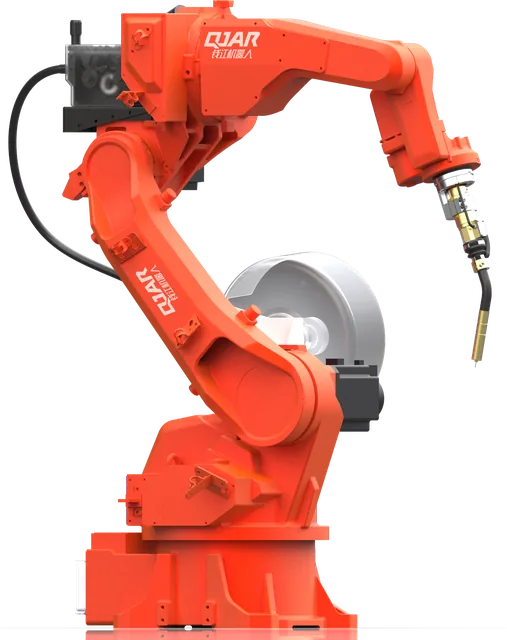
It is welding in which a 6-axis industrial robot carries the torch, or the spot welding gun, along a programmed path, with constant travel speed, angle and electrical parameters. The robot works together with the welding power source, the positioner and the fixture that holds the part, inside a guarded area.
The complete system is the robotic welding cell, covered in its own article. Here the focus is the process and the decision to automate.
Processes the robot runs
ISO 4063 assigns a reference number to each welding process. Processes used in robot cells:
| Process | No. in ISO 4063 | Typical use with a robot |
|---|---|---|
| MAG with solid wire | 135 | Carbon and low-alloy steel: structures, implements, auto parts |
| MIG with solid wire | 131 | Aluminium and other non-ferrous alloys |
| MAG with flux-cored wire | 136 | Joints that demand a given deposition rate or specific properties |
| TIG | 141 | Thin sheet and stainless steel where finish matters |
| Resistance spot welding | 21 | Overlapping sheets, with the gun mounted on the robot wrist |
MIG and MAG lend themselves to automation because the wire is fed continuously and the deposition rate is good. In spot welding, the gun rides on the wrist and usually calls for a high-payload robot. In arc welding the tool is light, and what counts is repeatability and reach.
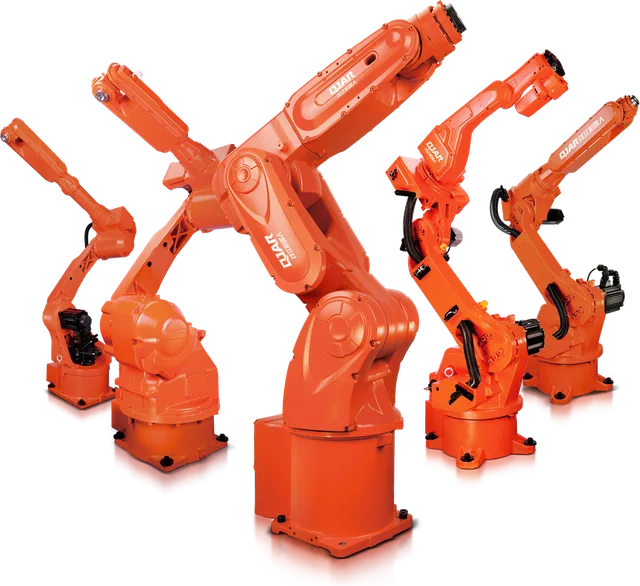
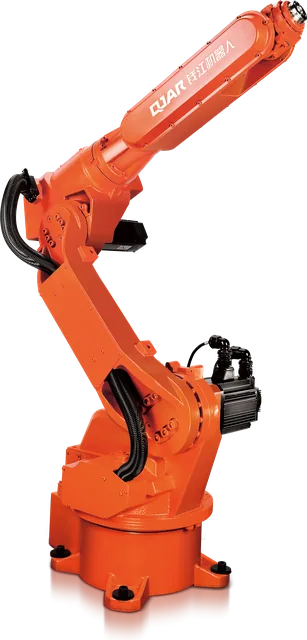
The QJAR line has three models dedicated to arc welding, with reach from 1,410.5 mm to 2,014 mm and repeatability from ±0.03 mm to ±0.08 mm. They are compared in the article on the robotic welding cell, and each figure is explained in the industrial robot guide.
Where the gain comes from
Arc-on time
The indicator that best explains welding productivity is the fraction of the shift in which the arc is actually on. In manual welding that number is low: in an article in The Fabricator, a welding engineer at a maker of automated welding systems says arc-on time is typically between 5% and 20%, with 10% to 15% in ordinary shops. The rest is positioning the part, changing position, cleaning, measuring and resting.
For fully automated welding, Canadian Metalworking cites arc-on time in the range of 80% to 90%. A cell with manual part loading stays below that ceiling, because it depends on changeover time, but that is the order of magnitude of the difference. Two-station layouts exist precisely so that the operator loads one part while the robot welds the other.
Constant parameters
Travel speed, contact-tip-to-work distance, torch angle and current do not vary from the start to the end of the shift. The result is a bead with the same geometry on the first and on the last part, which reduces overwelding, spatter and rework.
Predictability
With fixed path and parameters, cycle time becomes planning data. The plant knows how many parts the cell delivers per shift, which manual welding rarely allows with the same precision.
What the part needs
The robot repeats the path with a scatter of hundredths of a millimetre: ±0.03 mm to ±0.08 mm in the welding models of the line. If the joint arrives 2 mm out of position, the error is in the part, not in the robot. That is why the assessment of a project starts before the weld.
- Upstream repeatability. Cutting, bending and tacking must deliver the joint in the same place and with the same gap every time.
- Access. The torch has to reach every bead at the correct angle. Sometimes a small product change frees an entire weld.
- Fixturing. The fixture defines where the part is. It turns manufacturing tolerance into a known position.
- Part families. Similar parts share fixtures, programs and positioner, and spread the investment.
Sensing features exist to locate the joint and follow deviations. They widen what can be automated, but they do not replace a well-prepared part. Which features are included is a project decision, case by case.
Quality and qualification
Automating does not waive the welding quality system. The procedure still has to be specified and qualified, and the bead still has to be inspected. What changes is who has to be qualified and how.
- ISO 14732 sets out the qualification of welding operators and weld setters for mechanized and automatic welding.
- ISO 3834 defines quality requirements for fusion welding in workshops and on site.
- ISO 6947 standardizes welding positions. With a positioner, the cell brings the joint to the flat position (PA), the most favourable for deposition.
A well-run cell can also produce records: parameters per part, alarms and production counts become available for traceability.
Health and safety
In 2017, the International Agency for Research on Cancer (IARC) classified welding fumes as carcinogenic to humans, Group 1. The evaluation is in volume 118 of the IARC Monographs. A robot cell moves the worker away from the fume plume and from arc radiation, but it does not remove the need for capture and extraction at the weld point.
The cell is also a machine. In Brazil it is subject to NR-12, the machinery safety regulation: guards, interlocks, emergency stop and documentation. The requirements are in the article on NR-12 for robot cells.
When it pays off
| Signs in favour | What to prepare first |
|---|---|
| Repeated parts or families of similar parts | Cutting and bending tolerances that vary from batch to batch |
| A lot of weld length per part | Joints with no torch access |
| Two or three production shifts | Fixtures that do not guarantee joint position |
| Difficulty hiring and retaining welders | Product still under frequent design change |
| Rework caused by variation between welders | Nobody on the team who masters welding parameters |
The right-hand column is not a reason to give up. It is the list of what enters the project scope. Many viable cells start with an adjustment in cutting or with a new fixture.
The financial calculation follows the same logic as any cell: total investment against net annual gain, with the number of shifts among the heaviest variables. The method is in industrial robot cost.
How to start
A serious assessment starts from part data, not from a robot catalogue:
- drawing or 3D model of the part and its joints;
- material and thicknesses;
- total weld length per part;
- annual volume and batch size;
- present welding time and number of shifts;
- standard or acceptance criteria for the bead.
With that, a robot integrator can tell whether the case calls for a simple station, a positioner or a track, and which robot fits.
Frequently asked questions
What is robotic welding?
It is welding in which an industrial robot carries the torch or the spot gun along a programmed path, at constant speed and parameters. The power source, the positioner and the fixtures work in sync with the robot inside a guarded cell.
Which welding processes can a robot run?
Robots run arc welding with continuous wire, such as MIG and MAG (processes 131 and 135 in ISO 4063), on carbon steel, stainless steel and aluminium. They also run TIG (141), resistance spot welding (21) and laser welding (52), each with its own tool and power source.
Does robotic welding replace the welder?
It changes the role. The cell needs someone who knows welding to set parameters, assess the bead and correct the path. ISO 14732 covers precisely the qualification of welding operators and weld setters for mechanized and automatic welding.
What part volume justifies a robotic welding cell?
There is no single number. What weighs in is the weld length per part, the number of shifts, the part variety and the changeover time. Families of similar parts, even in medium batches, often make the project viable because they share fixtures and programs.
Does the part need to change to be welded by a robot?
Often yes, in details. The robot repeats the path and does not compensate by itself for a joint out of position. Cutting and bending must deliver parts within tolerance, and the design may need small changes to give the torch access.
Talk to BR Robotics
BR Robotics integrates QJAR welding robots in Brazil, with welding power source, positioners and track from the same manufacturer. Send the part and the volume: the reply comes with the recommended model and the cell layout. Talk to BR Robotics or see the robot and peripherals line.
Sources
- ISO 4063:2023, Welding, brazing, soldering and cutting: Nomenclature of processes and reference numbers
- ISO 14732:2025, Welding personnel: Qualification testing of welding operators and weld setters for mechanized and automatic welding of metallic materials
- ISO 3834-2:2021, Quality requirements for fusion welding of metallic materials: Part 2: Comprehensive quality requirements
- ISO 6947:2019, Welding and allied processes: Welding positions
- IARC Monographs, volume 118: Welding, Molybdenum Trioxide, and Indium Tin Oxide
- The Fabricator, "Automating welding starts with asking the right questions" (2026)
- Canadian Metalworking, "Is it time for an automated or semi-automated welding system?" (2023)
- EVST Brasil, QJAR line datasheets